


Thank you to all the children from North East primary schools and partner schools abroad who took part in the Calligrams Celebration, as part of Express Yourself: North East Festival of Languages 2026. 2,075 children aged 7-11 from 27 schools took part and drew images with associated words in different languages.
Schools submitted a selection of these creations, which have been made into two e-books, one for 7-9 year olds and one for 9-11 year olds. Some will also feature in the national Calligrams ebook due out shortly.
- Click here to download the 7-9 year olds Calligrams Celebration ebook
- Click here to download the 9-11 year olds Calligrams Celebration ebook
Some examples of the calligrams received from primary schools
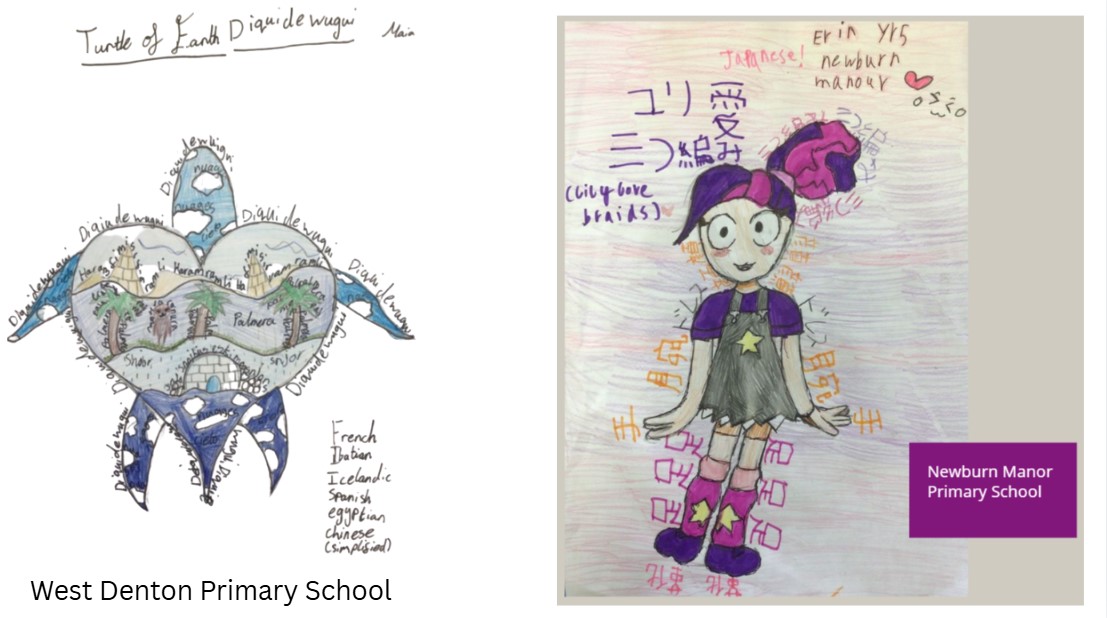


The Festival entries to the Calligrams celebration this year have been varied and unique, reflecting the personalities of the children who created them – not only in the North-East region but also at twin schools abroad.
Thanks to all of the teachers who inspired their children to participate.
I hope your Festival Certificate will encourage your Headteachers, parents and Governors to congratulate everyone in your classes on their language skills!
E-books for two volumes (ages 7-9 and 9-11) are available, so that teachers can share them on screen in schools, and online with families and friends to keep the celebration going!
Steven Fawkes, Calligrams Celebration Lead
Co-President of the Association for Language Learning
Further information
Just over a hundred years ago, at the end of the First World War, the French poet Guillaume Appollinaire published a set of poems called Calligrammes in which he used ink and fonts to draw recognisable shapes with connected words.
Primary children were invited to make their own calligrams, using words and/or phrases they have learnt in any language other than English, as part of a Calligrams Celebration during the Festival of Languages 2025 from January to the end of March. Schools submitted a selection from their pupils’ creations to be added to the ebooks. There were 2 categories – 7-9 years old and 9-11 years old, and invite teachers to select a theme that fits in with their schemes.
What is a calligram? The words might draw the outline of the image, or fill in the silhouette of the image. The key things are that they should be related to the image, they should be easy to read (neat and not over-elaborate), and they should be spelled correctly. They can be created by hand or with a computer.
How can we use calligrams to enhance teaching and learning a language? Pupils are introduced to them in Y3 Literacy in England and so it’s a concept with which they may are already be familiar. In Y3 they look at examples of calligrams and then have a go at making their own using ICT.
Acknowledgements
- Special thanks to Steven Fawkes at Association for Language Learning North East for running this competition and to Crista Hazell, Association for Language Learning, for the creation of the ebooks
- Thank you to all the children and schools who took part
The Festival is part-funded by the North East Combined Authority
