


Local teacher, Rebekah Walker, from St. Paul’s Primary School in Newcastle, attended a glittering national ceremony with other UK teachers at the Houses of Parliament in February to receive their Accreditation for International School Award. This marks years of work by the school to embed internationalism across the curriculum and provide wide ranging opportunities for their pupils to develop themselves as global citizens. Congratulations St. Paul’s!
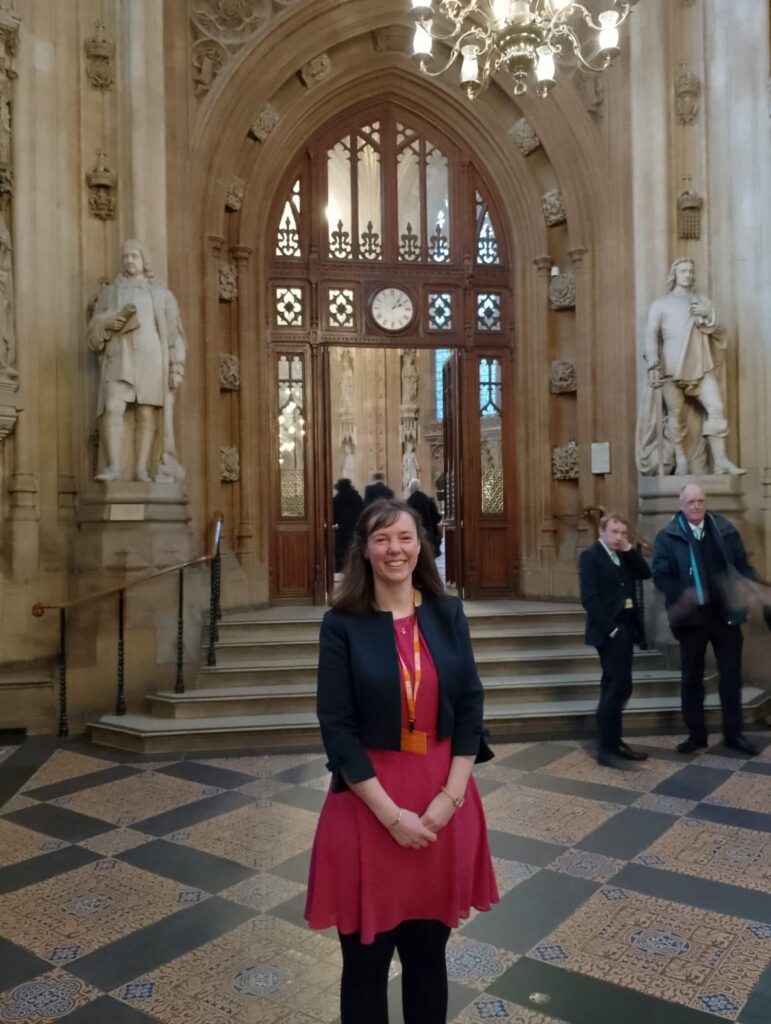
Rebekah at the Houses of Parliament
It was a wonderful event and especially to celebrate the work of our school and others taking part in the International School Award. At St Paul’s we have built a wide range of activities and experiences across the curriculum to ensure that internationalism is embedded and also that we are maximising the benefit for our children.
We had already done lots of work around the UN’s Sustainable Development Goals, with our partner schools in Nancy (France) and Rajkot (India) and take part in a lot of activities during the annual Express Yourself: North East Festival of Languages. This provides such a variety of experiences for our pupils – from curriculum subjects to exploring world languages and cultures such as Japanese and Arabic. We even had a photography exhibition in school, with a parent who trained the children.
We will continue to work on expanding the diversity of activities and opportunities for our children as global citizens.
Rebekah encourages other schools to take part and has shared her experience with Newcastle schools to encourage involvement and explain the process, which she says has become much simpler (see webinar link below).
The feedback from British Council shows how outstanding the work of Rebekah and the team at St. Paul’s has been and highlights the key elements which has made their approach worthy of the full accreditation:
It is hard to imagine a better application for International School Award Accreditation than the submission I have just read from St Paul’s Primary School in Newcastle. You have met the standard in every possible way. The school’s commitment to the international dimension is outstanding. Well done! You have assembled a compelling body of evidence to show your commitment to the International School Award programme and have met the requirement for the minimum of seven eligible activities across the academic year 2024-2025.
All the activities are good and some so innovative or dynamic that I have recommended them to the British Council team as examples of good practice. In particular, I am thinking of “Maths and Music” with your partners in Nancy, the “Change the world – photography” with the help of a parent ‘in the trade’ and “a refugee’s experience”. What is then particularly enriching is that they are linked neatly into your Internationalism at St. Paul’s website tab without being over complicated, more good practice. I noticed several local links with universities, Nissan and the City of Newcastle in general which demonstrate even wider engagement. Most pupils are involved in most activities. Three are collaborative with Nancy and have a significant foreign language element.
The introductory description starts strongly with a reference to the Sustainable Development Goals, always a useful focal point. And the fact that 15 pupils were able to visit Rajkot in 2024 and others to Nancy is very impressive.
Newcastle Schools and the ISA
International Newcastle and Newcastle City Council (School Effectiveness) promote the involvement of schools with British Council’s International School Award (ISA) as a means to embed internationalism across schools and enrich the curriculum and broaden children and young people’s horizons. This is a motivational framework for schools to embed internationalism across the curriculum and help prepare children and young people for life in a global society. Participating in Festival activities supports schools’ progression through the ISA levels.
Over two thirds of Newcastle schools already have some level of ISA, from the Foundation Certificate, Intermediate and a few with full Accreditation – the highest level of ISA. Sarah Edgar (School Effectiveness) and Declan Baharini (IN Chief Executive and Express Yourself North: East Festival of Languages Co-ordinator, work with the British Council’s ISA team and local schools (and region-wide and UK-wide through the Festival) to promote activities which support schools’ ISA journeys and sharing learning to promote involvement in and get the most out of the award programme for pupils.
A webinar we recorded in November 2025 provides information for schools from British Council’s International School Award Team. Rebekah shares the experience of St Paul’s achieving Accreditation – the kinds of activities they have been doing in school, with the Festival of Languages and their international school partners. It also has input from Declan about how Festival 2026 activities can support and inspire schools to progress through the ISA levels from Foundation Certificate, to Intermediate and Accreditation levels. Click here to watch the webinar recording.
About the International School Award

British Council’s International School Award (ISA) provides a framework for schools to develop international activities across the curriculum, including collaborative work with international partner schools and opportunities to involve the wider community. Schools can start at Foundation level and then achieve accreditation as they develop through the levels. The International Schools Award celebrates and recognises the international work that schools do. The programme encourages schools to open their classrooms and bring the world in, teaching pupils about other countries and cultures.
- No cost for applying, some staff time is needed
- A supportive and motivational framework to guide the school’s international learning activities
- Can be adapted to any curriculum at any level from nursery to 6th form colleges and special schools
- Any school in the UK that is delivering one of the national curricula can apply for the International School Award (3 to 18 years) and there is a lot of flexibility to suit students’ abilities
The International School Award:
- prepares young people for life in a global society by increasing their understanding of other countries, cultures, and global issues
- provides a motivational framework for teachers to develop themselves professionally (Leading on this work in school gives more opportunities for professional development, working with colleagues in other countries and supporting progression)
- recognises a school’s commitment to developing global citizenship in young people, and gives opportunities to raise the school’s profile through local and national media (Media packs are provided to schools to share news with local media)
Click here to find out more about the International School Award, guidance on how to apply, criteria and benefits.