British Council hosted a brilliant webinar this week with three people from the North of England who have inspiring language and career journeys. The speakers showed how learning and speaking other languages opens doors to adventure, travel, friendships and interesting careers, which can take you all over the world.
The intention was to help young people see the value in speaking their home languages and languages they are learning at school and to influence them to make positive choices and take languages at GCSE and A Level.
More than 5,000 young people from over 60 schools watched the webinar live on 18th March and over 20,000+ young people will access the recording, which will also be available free to schools on British Council’s website soon. The webinar was provided as one in a series of languages and careers webinars, as part of Express Yourself: North East Festival of Languages 2025, supported by International Newcastle’s Chief Executive Officer, who is the Festival Co-ordinator.

Helena grew up on a farm in the Lake District. She learned French at school, but didn’t really enjoy it until she visited Marrakech in Morocco, where she realised could communicate with people in French, which sparked her passion to learn more.
She went on school exchanges in France, took A Level French and then had a gap year in Canada, where French was useful. She volunteered in Burkina Faso, where she could communicate in French and teach English and French. She also worked as an aupair in Monte Carlo, before going to university.
She studied Arabic at university and had a year abroad in Jordan, as part of her course and travelled around Jordan and Egypt. She took another gap year after university in Mexico, learning Spanish and exploring and volunteering across the country.
It doesn’t matter if you are not fluent in the language, the most important thing is to be understood, to communicate and to ask questions and answer them.
She now works for British Council on their Language Assistants Programme, working with the Spanish Education system and supporting language assistants from Spain to work in UK schools. Her role involves communicating online, but also travel to Spain to meet in person. Helena’s language skills enable her to listen, speak, prepare reports and follow up actions. Travel helped her develop problem solving skills, adaptability and resilience and with her language skills, to make friends all over the world, learn more languages and widen her perspectives.
Languages help you make friends all over the world and learn about different languages and cultures… if you can speak different languages – the more the better – it opens opportunities.
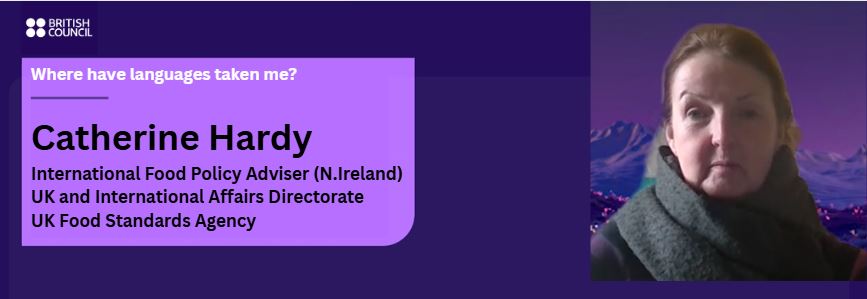
Catherine grew up in Blyth in Northumberland and went to school in Newcastle. She went abroad for holidays and studied Latin, which she described as a gateway language. She did A level French and went on to study French, Linguistics and Swahili at the University of York.
She had a year abroad in Marseille in France with her degree and said that she met lots of different people and and was immersed in a vibrant, diverse, multicultural city, which was a culture shock, but a wonderful experience.
After working in BBC radio and television as a reporter, newsreader and programme producer, she moved to France to work for Euronews. There she worked as a correspondent, producer and editor working with journalists from 14 different language services. She said that the cultural insights, the value of diversity and the first-hand experience and knowledge of global events were incredibly valuable, as well as the fantastic social life!
She went on to work at the European Parliament press office in Brussels and the European Broadcasting Union in Geneva – with a highlight being working on the 60th anniversary of the Eurovision Song Contest. She is now based in Northumberland, but works with UK Government and Northern Ireland and the European Union around European food law.
If you are interested in the world you live in and in people then learn languages and learn as many as you can. Once you’ve learned one, you can learn more – you don’t have to be fluent, just give it a try.
She said that being paid to travel has been a bonus and that she has a global network of friends. She stressed how the concrete and transferable skills she has gained has helped her find interesting jobs and that languages, work and travel have added a richness to her live that she would otherwise never have had.
The third speaker cannot be named for security reasons. He was from the North, studied French and German at school and Korean and Politics at university, as well as modules in Spanish. Spending his university year abroad in Korea and worked for a Korean company before going on to work for GCHQ, which is one of the UK Government’s intelligence agencies, along with MI5 and MI6.
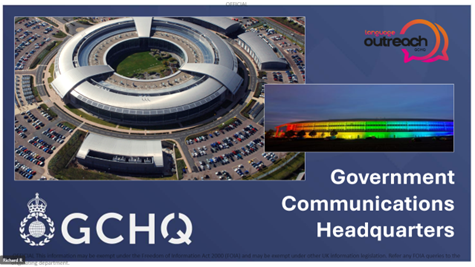
In Signals Intelligence they collect information, translate it using their language skills and analyse the data and turn it into intelligence for the Government to stop threats to the UK and allies, including terrorism, weapons WMD, organised crime and other threats. They work closely with the other intelligence agencies and the police and military, providing the Home Office, Ministry of Defence, Foreign Office and no.10 with information.
R said he works with languages every day. His job is more than translating. As intelligence analysts, they mentor others in the team to improve their own skills. The job takes him around the world to work with partners. He said there is a lot of information on the website about what we do at GCHQ and a great mixture of people and skills including languages, translators, analysts, cyber skills, technical people – a mix of minds that come together to protect the UK. He also talks to young people who are the spies of the future.
QUESTIONS & ANSWERS
Vicky Gough from British Council Schools, hosted a Q&A session, so that young people watching the webinar could ask questions of the three speakers.
Catherine was asked why she went into journalism and whether she reported in English or French. She said that her grandfather was a journalist and it is a really creative profession. She went from being a student journalist in university to the BBC in Newcastle at first. She said you always report in your native language, but work with colleagues who speak other languages to understand the news and what is happening.
R the spy was asked whether he had ever worked with James Bond, what it is like to do a job where you can’t tell anyone what you are doing and how to get a job at GCHQ. He said that he has worked with people who work for the same organisation as James Bond. He said that being a spy is exciting and that because you can’t do any work away from GCHQ, then you can switch off at home. He said that it can be frustrating, but there is lots of support and assistance available for people working at GCHQ. He said that there is a careers section on GCHQ’s website and you can find out more there. R said that people with home languages and those who have learned languages are highly valued, but there are lots of different skills needed by GCHQ.
When asked the best way to learn a language, all three speakers said that being immersed in the country is the quickest and best way, as you have to pick up the language, you make friends and you also learn about the culture. Helena also said that it is important to find something you are interested in or motivated by – films, music, history or the language and then make friends who speak those languages and talk to them.
Further links and information
- Festival: Click here to find out about other languages and careers webinars and events delivered free as part of Express Yourself: North East Festival of Languages. Also discover the curated collection of resources about languages and careers. These are designed to help teachers, careers advisers, parents and others support young people to understand why languages are so helpful in opening up opportunities for personal development, future education and careers.
- British Council:
- Click here to find more ‘Where will languages take me?’ videos and resources from British Council and click here to access the pupil booklet that accompanies these resources
- Click here to find out about the wide range of resources for schools from British Council to enrich the quality of education in schools and equip young people to live and work successfully in a global society.
- Read more about how British Council can support the teaching of languages in your school here: Support for language teaching | British Council.
- Click here to find out more about British Council’s Language Assistants Programme (schools can apply for Language Assistants in French, German, Spanish, Italian and Irish up to 30th April and Mandarin up to 2nd April)
- GCHQ:
- Click here to find out more about GCHQ
- Click here for the GCHQ careers website
- GCHQ hold a national language competition every November for schools – click here to find out more
Acknowledgements
- Thank you to British Council colleagues, Vicky Gough, Rachel Flatman and Lorna Payne, for engaging the speakers, developing and hosting the webinar and providing it free to schools as part of Express Yourself: North East Festival of Languages
- Special thanks to the three speakers – Helena Watson, Catherine Hardy and R for such stimulating contributions and sharing their personal stories, language and career journeys


The Festival has been part-funded by the North East Combined Authority